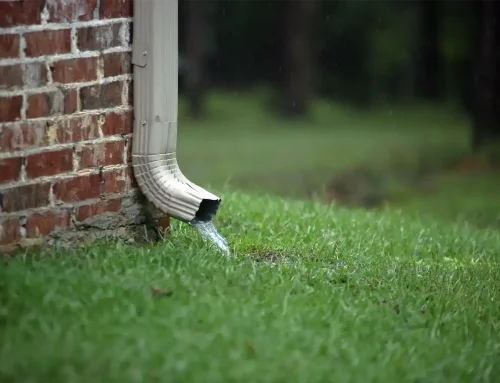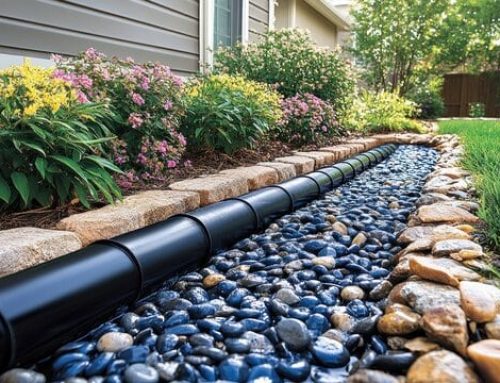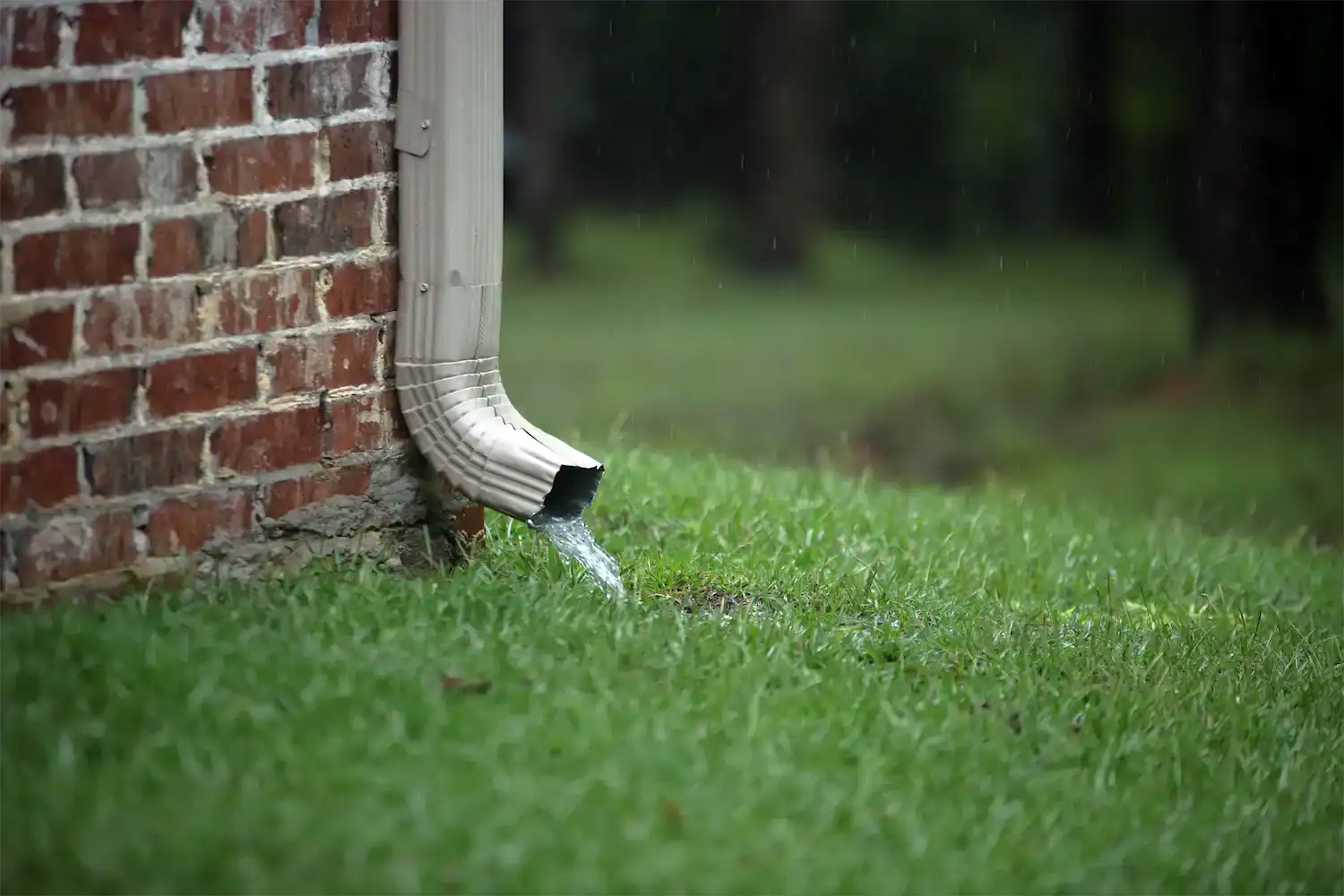

French drains and downspout extensions solve two different problems. A downspout extension deals with roof water, carrying it from the downspout to a safe distance from your foundation. A French drain deals with ground water, collecting water that is already in the soil or flowing across your property and moving it somewhere harmless. If your water problem comes from roof runoff landing near the house, which is the most common situation on Toronto homes, a properly installed downspout extension is the right solution. A French drain makes sense when water is coming through the soil or from higher ground and cannot be redirected by extensions and grading alone. Many homes only need extensions. Some need both. Very few need only a French drain.
Understanding the difference before work starts is the best way to avoid a bigger, more disruptive solution than the problem requires.
Two different kinds of water
Roof water is concentrated and predictable. It arrives fast, during the storm itself, and it arrives at a handful of known points: the bottom of each downspout. Every millimetre of rain on one square metre of roof makes one litre of water, so a 25 mm storm on a 120 square metre roof sends around 3,000 litres to those few outlets.
Ground and surface water is spread out and slower. It is rain soaking into the lawn, runoff crossing from a neighbouring lot, or water moving through the soil after the storm has passed. It does not come from one point, so it cannot be fixed at one point.
The question is not which product is better. It is which kind of water is causing your problem.
Downspout extensions
A downspout extension carries water from the bottom of the downspout to a point where it can drain away from the house. Options include:
- Above-ground extensions in aluminium or vinyl, fixed or hinged to flip up for mowing
- Flexible extensions that can be routed around obstacles
- Buried solid pipe that carries water underground to a discharge point further away
Where they work well: puddles and erosion at the base of a downspout, damp basement corners directly inside from a downspout, and water in a window well near an outlet. As a general rule, water should discharge at least 1.8 metres from the foundation, onto ground that slopes away. See How Far Should a Downspout Extend From Your Home?
Limitations: above-ground extensions can get in the way of walkways and lawn mowers, and they do nothing for water that is not coming from the roof. Buried lines need careful slope, enough depth and a proper outlet to avoid freezing and blockages. Our article Should Downspouts Be Buried or Extended Above Ground? covers that decision.
French drains
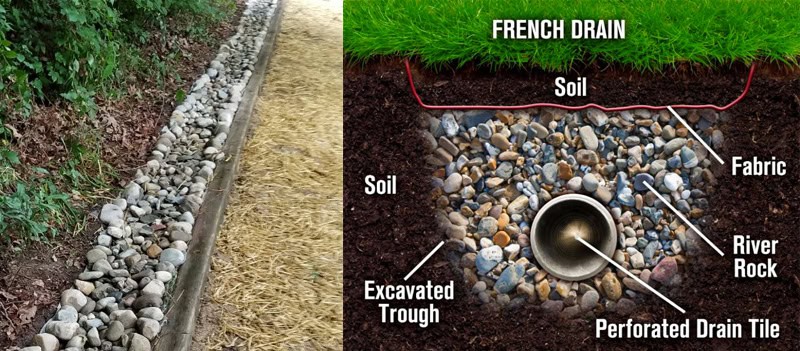
A French drain is a gravel-filled trench with a perforated pipe along the bottom, wrapped in filter fabric. Water in the surrounding soil finds the easy path through the gravel, enters the pipe, and runs downhill to an outlet. We explain the design in detail in What Is a French Drain and When Does a Home Need One?
Where they work well: yards that stay soggy for days after rain, water arriving from a higher neighbouring property, low spots between houses, and a slope toward the house that cannot be regraded because of a driveway, retaining wall or property line.
Limitations: a French drain involves excavation and a real outlet at a lower point. It needs correct fabric and clean stone to avoid silting up over time. And it is not designed to take roof water.
How they compare
| Downspout extension | French drain | |
|---|---|---|
| Water it handles | Roof runoff from a single downspout | Water in the soil or crossing the property |
| Typical sign | Pooling or erosion at the base of a downspout | Soggy ground away from downspouts, days after rain |
| Disruption | Minimal above ground; some digging if buried | Trenching and landscape restoration |
| Winter | Outlets must stay clear; shallow buried lines can freeze | Works below the frost line; shallow ends and outlet can freeze |
| Maintenance | Keep outlets clear, check connections | Keep the outlet clear; inspect if water returns |
| Most common failure | Too short, or discharging onto ground that slopes back | Silting up, or no proper outlet |
Which one does your home need?
- A puddle forms at the bottom of a downspout: an extension, plus some regrading at the discharge point if needed.
- A basement corner is damp right below a downspout: start with the extension. Fixing the roof water often solves it.
- The whole side yard stays wet, nowhere near a downspout: a grading problem or a French drain, depending on whether the ground can be reshaped.
- Water runs onto your lot from a higher neighbouring property: often a French drain or swale along the property line.
- A narrow side yard between two houses floods: common in older Toronto neighbourhoods, and often needs a combination: downspout water carried away in solid pipe, plus a drain or swale for the ground water.
Why downspouts should not drain into a French drain
It is tempting to send downspout water into a French drain, since both are about moving water. In most cases it is a mistake.
A French drain is designed to collect groundwater slowly along its length. A downspout delivers a large volume of water in a short burst at one point. Dropping that into a French drain overwhelms it, can push water back out into the soil near the foundation, and adds sediment and roof grit that speed up silting. In winter, a line carrying roof water is also more likely to freeze and back up.
Where roof water does need to travel underground, it belongs in solid, non-perforated pipe sized for storm flow, discharging well away from the house, and kept separate from any groundwater collection system.
Start with the roof water
The practical order of work is the same on almost every property. First, make sure roof water is leaving the house properly: clean, well-sloped eavestroughs and downspouts that discharge far enough away onto ground that falls away from the foundation. Second, correct the grade around the house. Then reassess. If water is still collecting, a French drain is a well-justified next step rather than a guess.
Frequently asked questions
Can a downspout extension be buried?
Yes, using solid pipe laid with continuous slope to a proper outlet. Shallow or poorly sloped buried lines are prone to freezing and blockages, so installation matters as much as the decision to bury.
Is a French drain overkill for a wet basement?
It can be. If the water is coming from roof runoff near the foundation, extensions and grading are the right first steps. A French drain is justified when water is moving through the soil or from neighbouring ground.
Will downspout extensions alone stop basement leaks?
Often, when the source is roof water landing near the wall. They will not stop leaks caused by failed weeping tile, foundation cracks with other water sources, or high ground water.
Do I need a permit for a French drain?
It depends on your municipality, the scope of the work and especially where the water discharges. Rules differ across the GTA, so it is worth confirming with your local building department before work begins.
Choosing the right solution
The best drainage fix is the simplest one that matches the source of the water. For most Toronto homes that means getting roof water away from the foundation first, and only then deciding whether ground water needs its own solution.
Ontario Downspout Service is a licensed and insured residential drainage specialist serving Toronto and the GTA, and a Best of HomeStars winner for more than ten years. We install both downspout solutions and French drains, so we can tell you honestly which one your home actually needs.