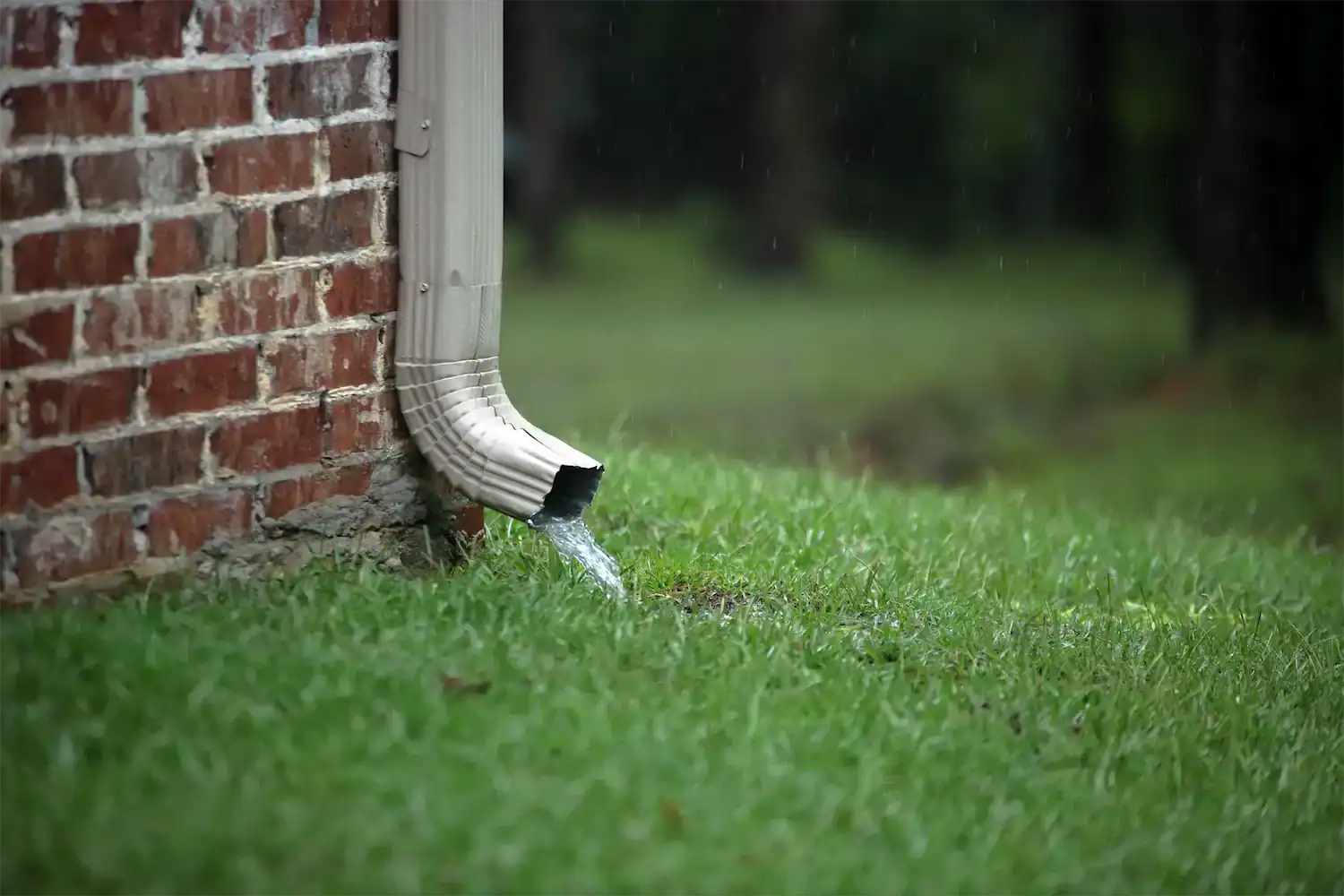
As a general rule, a downspout should discharge water at least 1.8 metres (about six feet) away from your foundation wall, and further on heavy clay soil or where the ground is close to level. But distance alone is not the whole answer. A downspout that extends six feet onto ground sloping back toward the house is worse than one that extends three feet onto ground sloping away. What matters is where the water goes after it leaves the pipe.
This is one of the most common drainage problems we find on Toronto homes, and one of the least expensive to correct — which makes it worth checking on your own house this week.
Why the standard distance exists
Foundation walls are backfilled during construction. That backfilled soil is looser and more permeable than the undisturbed ground around it, so water reaching the surface near the wall tends to travel straight down through the backfill rather than spreading outward.
The zone of disturbed soil typically extends a metre or more from the wall. Discharging beyond it means water meets denser, undisturbed soil and moves away instead of down. Discharging within it sends concentrated roof runoff directly into the most permeable path available — a channel leading down the outside of your foundation.
Remember the volume involved. A 1,500-square-foot roof sheds roughly 3,500 litres during a 25 mm rainfall. Split across four downspouts, that is nearly 900 litres from each one, arriving in a short burst.
Distance is necessary but not sufficient
Three factors determine whether an extension actually works:
1. Grade at the discharge point
The ground where water lands needs to fall away from the house — roughly 15 cm of drop over the first two metres is a common target. Many Toronto properties have settled over decades and now slope gently back toward the foundation. On those homes, a longer extension just delivers water to a low point that drains toward the wall.
2. Soil type
Much of the GTA sits on clay-heavy soil, which absorbs water slowly. On clay, water tends to pool at the discharge point and spread across the surface rather than soaking in, so extensions generally need to run further than they would on sandy ground.
3. What is downhill of the discharge
Water directed away from your foundation still has to go somewhere sensible. Common mistakes include aiming a downspout at a neighbour’s property, at a walkway that ices over in winter, or toward a window well — which converts a foundation problem into a direct entry point.
The Toronto downspout disconnection bylaw
Toronto City Council approved a bylaw making downspout disconnection mandatory across the city, phased in with a final deadline of December 3, 2016. Downspouts that once discharged into the sewer system must now release water onto the property instead, with exemptions available where disconnection is not feasible.
For homeowners, this changed the question. Water that used to disappear into a pipe now has to be managed at the surface — which makes extension length and grading far more consequential than they were a generation ago. Many older Toronto homes were built with downspouts connected to clay drain pipe underground, and those buried lines are often degraded.
How to check your own downspouts
Wait for steady rain and walk the perimeter:
- Measure roughly where each downspout releases water relative to the wall
- Watch which direction the water travels once it lands
- Look for pooling that persists within a metre or two of the foundation
- Check for splash marks or soil erosion at the base of each downspout
- Note any extension that has separated at a joint or been knocked out of alignment
Come back a few hours after the rain stops. Standing water near the foundation is the clearest signal that something needs attention. Our post on what to check after a heavy rainstorm covers a fuller inspection routine.
Common extension problems
Extensions removed for mowing and never replaced. Hinged or removable extensions get lifted in summer and forgotten. Weeks of rain then discharge at the wall.
Extensions that separate at the joint. Water escapes at the seam, often right at the foundation, while the extension appears intact from a distance.
Extensions ending at a low spot. Water travels six feet, then pools and soaks in — sometimes migrating back toward the house underground.
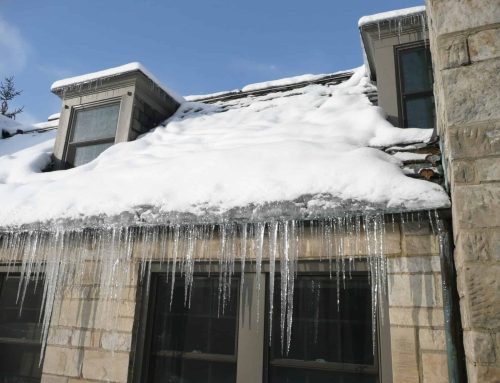
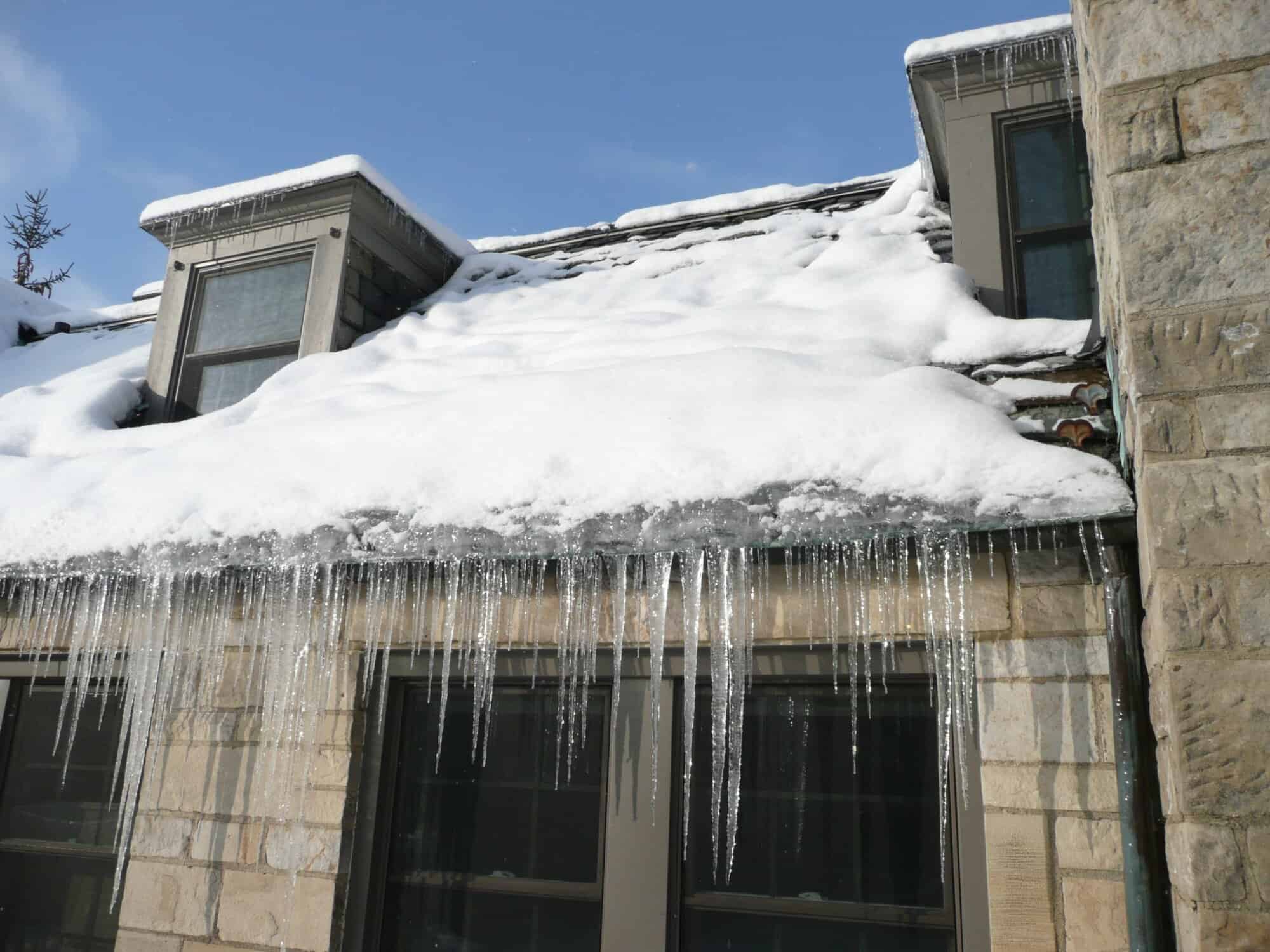
Winter icing. Extensions at ground level fill with ice, back water up into the downspout, and force it out at seams higher up. Our ice dam page covers related winter drainage issues.
When surface extensions are not enough
Sometimes there is nowhere good to send the water — a narrow side yard, a property that slopes toward the house, or a discharge point that creates problems elsewhere. In those cases, a subsurface solution such as a French drain can carry water to a better outlet.
This is worth assessing properly rather than guessing, since a buried line that fails is harder to diagnose than a surface extension you can see.
Frequently asked questions
Is six feet always enough?
It is a reasonable minimum, not a guarantee. On clay soil, on flat lots, or where a basement has a history of moisture, further is better. The real test is watching where water goes during rain.
Can I just use a splash block instead?
A splash block prevents erosion and disperses flow, but it typically moves water less than a metre. On its own it rarely achieves the separation a foundation needs, though it can help when paired with proper grading.
Should extensions be buried so they are out of sight?
They can be, but buried lines need proper slope, a viable outlet, and access for cleaning. Buried extensions that clog cause the exact problem they were meant to solve.
Do all downspouts need the same extension length?
No. Each one should be assessed against the grade and soil at its own discharge point. A downspout on a well-sloped side of the house may need less than one discharging into a flat corner.
Getting it right
Downspout extension is among the highest-value drainage corrections available to a homeowner, precisely because it addresses the point where roof water meets your foundation. Getting the distance, the grade, and the destination right removes a leading cause of basement moisture.
If you are not sure whether your downspouts are discharging where they should, we can assess your full system. Learn about our downspout and eavestrough services, or read Do Downspouts Really Protect Your Foundation? for more on the connection between roof water and foundation damage.