Winter affects roofs, eavestroughs and downspouts mainly through one process: water freezing where it should be draining. Snow melts on a sunny afternoon, refreezes overnight at the roof edge or inside the trough, and every cycle adds weight, blocks an outlet, or pushes water somewhere it was never meant to go. In Toronto, where winter temperatures hover around freezing for weeks at a time, that cycle repeats far more often than in places that simply stay cold. The results are familiar: ice dams, sagging or detached eavestroughs, frozen downspouts, and meltwater dumped against the foundation at the exact moment the ground is least able to absorb it.
The good news is that most winter drainage damage follows predictable patterns, and most of it can be prevented before the first hard freeze.
Why Toronto winters are especially hard on roof drainage
It is not the cold itself that causes most of the trouble. It is the swing back and forth across zero. Lake Ontario moderates the city’s temperatures, so a Toronto winter is full of thaws followed by sharp overnight freezes.
That matters because water expands by about 9 percent when it freezes. Water that has worked its way into a seam, a downspout elbow or under a shingle edge does not just sit there when the temperature drops. It pushes outward, opens the gap a little wider, and lets in more water the next time it melts.
Volume matters too. Toronto receives roughly 830 mm of precipitation a year, and a meaningful share of it falls as snow. All of that snow eventually leaves your roof as water, and it leaves through your eavestroughs and downspouts. As a rule of thumb, every millimetre of water on one square metre of roof is one litre. A 120 square metre roof shedding the equivalent of 25 mm of meltwater sends around 3,000 litres toward your drainage system, often in a single afternoon thaw.
What winter does to your roof
Ice dams at the roof edge
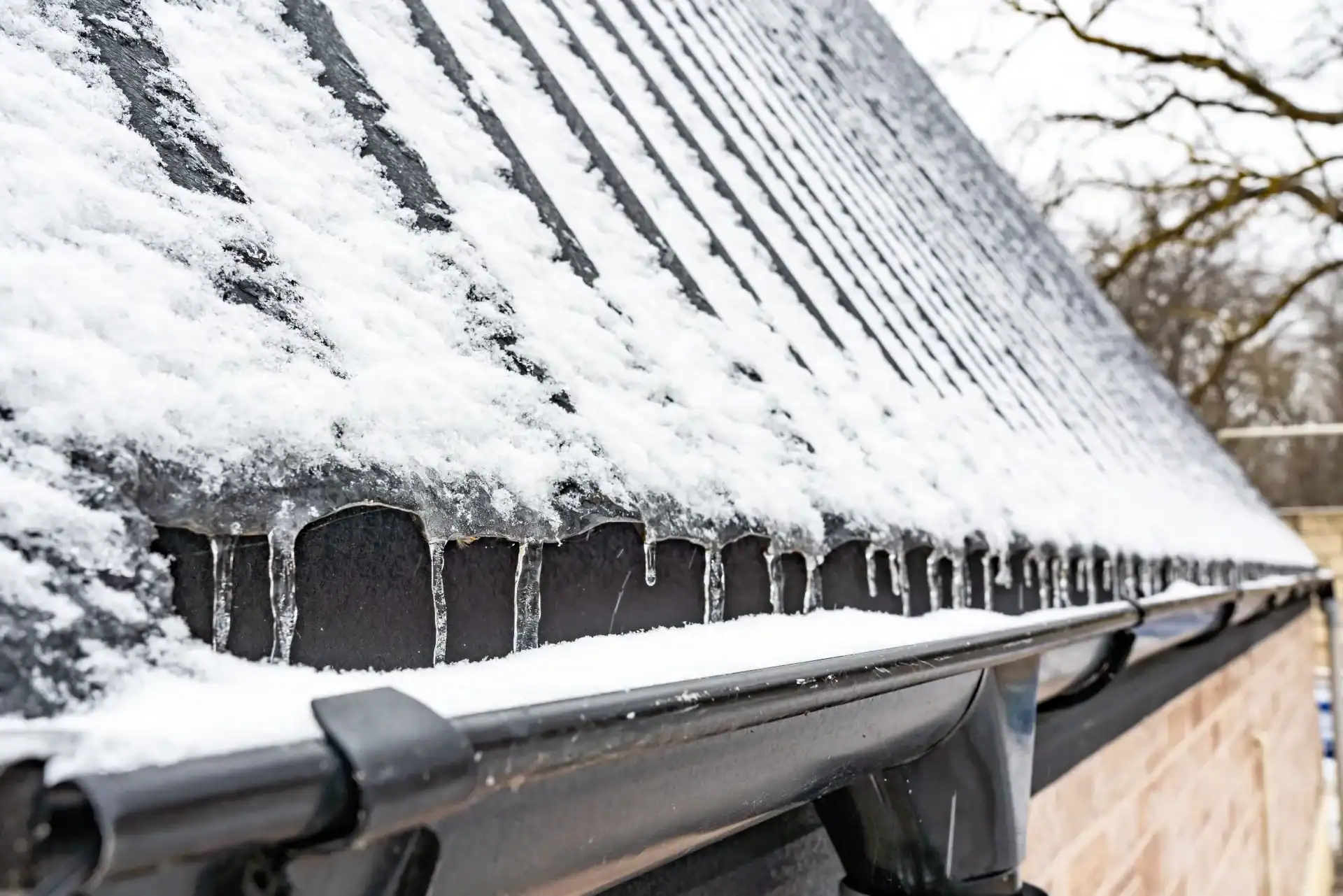
Heat escaping from the house warms the upper roof and melts the snow there. The meltwater runs down to the colder overhang, refreezes, and builds a ridge of ice. Water then pools behind that ridge and works its way under the shingles. We cover the causes in detail in Ice Dams vs Snow Buildup and explain why new shingles alone rarely solve the problem in Why Do I Still Get Ice Dams After a Roof Repair?
Snow load
Most pitched roofs in the GTA are built to carry a normal Toronto snowfall without trouble. The concern is heavy, wet snow combined with ice, particularly on flat and low-slope roofs where it does not shed naturally. These roofs also have their own ice dam pattern, covered in Ice Dams on Flat and Low-Slope Roofs.
Shingle and flashing stress
Freeze-thaw cycles find existing weak points: a lifted shingle, a worn flashing seal, a cracked boot around a vent. This is why many roof leaks show up during a thaw rather than during a storm.
What winter does to your eavestroughs
Ice-filled troughs and added weight
An eavestrough full of ice is many times heavier than an empty one. That weight pulls on the hangers and fascia, and over a winter or two the trough can sag, lose its slope, or pull away from the house entirely. A trough that has lost its slope then holds water in spring and summer as well.
Overflow at the wrong time
When the trough or outlet is blocked with ice, meltwater has to go somewhere. It spills over the front edge and lands at the base of the wall, or it runs behind the trough and soaks the fascia and soffit. Repeated winters of this cause the rot described in How Poor Roof Edge Drainage Can Damage Fascia and Soffits.
Damage from sliding snow and ice
On steeper and metal roofs, a whole sheet of snow and ice can release at once and strip or crush the eavestrough beneath it. See When Snow and Ice Slide Off the Roof and Damage Your Eavestroughs.
Icicles
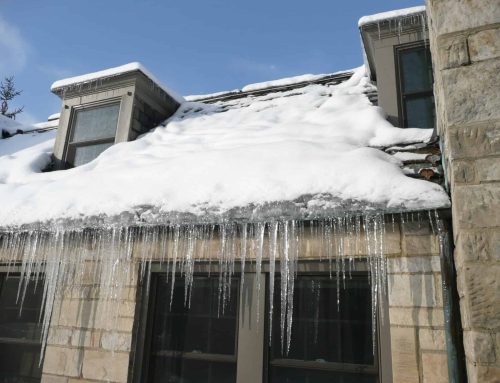
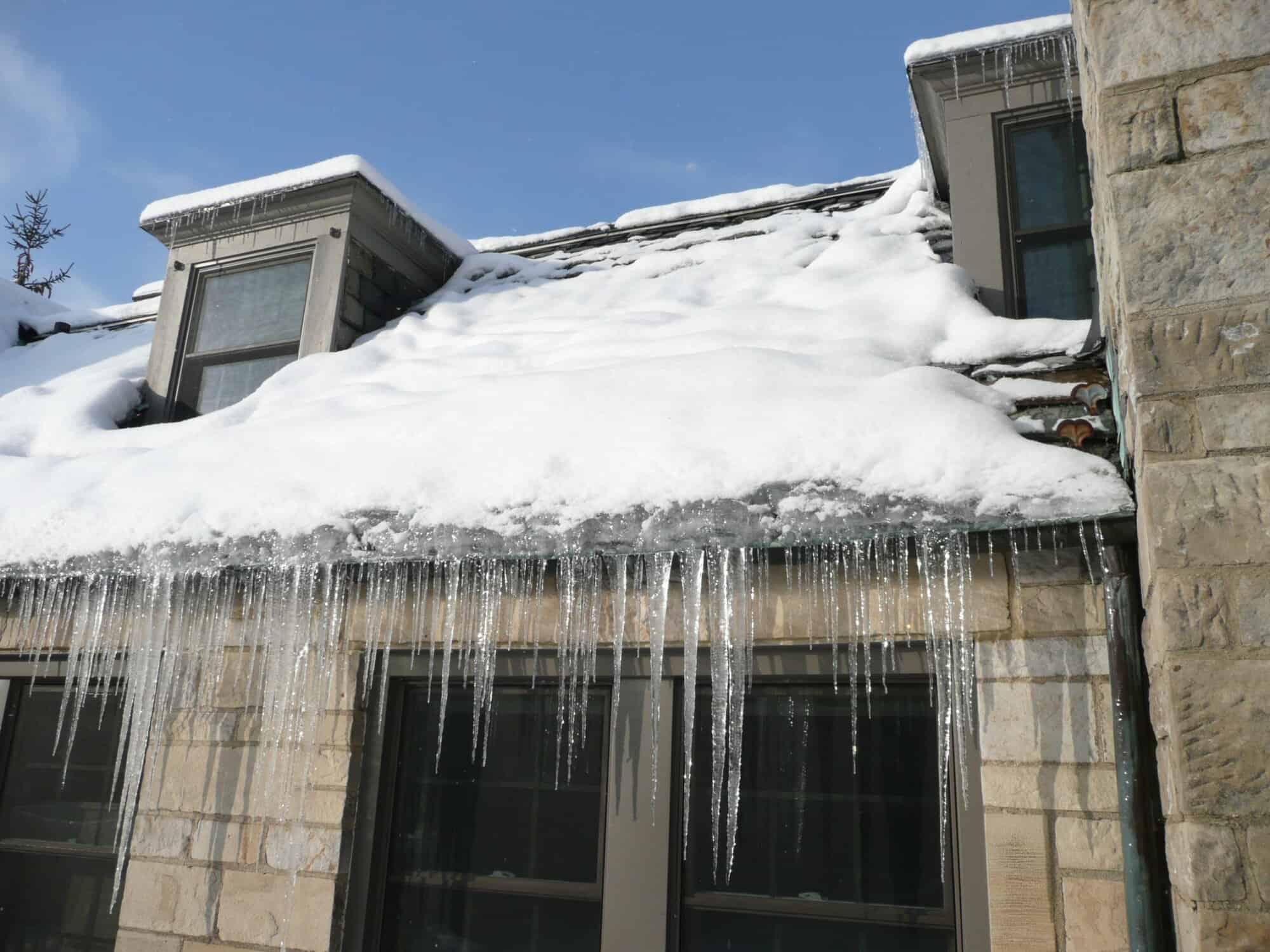
Large icicles are a symptom rather than a cause. They show you exactly where water is escaping the drainage system, and over doorways and walkways they are a genuine safety concern. More on that in Falling Ice and Icicles Over Doorways and Walkways.
What winter does to your downspouts
Frozen and blocked downspouts
Downspouts freeze from the bottom up, usually starting at the elbow or at a leftover clump of autumn leaves. Once the outlet is blocked, the whole downspout fills with ice and the trough above overflows. We explain the causes in Why Does My Downspout Freeze in Winter?
Split seams and bulging
A downspout packed with ice can split along its seam or bulge at the joints. The damage often goes unnoticed until spring, when water sprays out of the crack and soaks the wall.
Buried lines that freeze
Underground extensions that are too shallow or poorly sloped hold water and freeze solid, backing water up into the eavestrough. Our guide Should Downspouts Be Buried or Extended Above Ground? explains when burying makes sense.
Water landing on frozen ground
Frozen soil absorbs almost nothing. Meltwater released at the foundation runs along the surface, into window wells, and toward any gap at the base of the wall. That is why so many Toronto basements take on water during a February or March thaw. Proper discharge distance matters even more in winter, as covered in How Far Should a Downspout Extend From Your Home?
Warning signs to watch for this winter
All of these can be checked safely from the ground. Please do not climb onto an icy roof or lean a ladder against a frozen eavestrough.
- Icicles forming in the same section every time it thaws
- Ice on the fascia or siding below the eavestrough
- A trough that visibly sags or has pulled away at one end
- Downspouts that stay dry during a thaw while the trough above them drips or overflows
- A sheet of ice spreading from a downspout outlet across a walkway or toward the foundation
- New stains on ceilings or upper walls near exterior walls, especially after a mild spell
How to reduce winter drainage problems
Clear the system before it freezes. Leaves left in troughs and downspouts in November become ice blockages in January. Our checklist on preparing eavestroughs and downspouts before winter walks through the essentials, and professional eavestrough cleaning takes care of it without anyone climbing a ladder in cold weather.
Check slope and hangers. A trough that drains completely has nothing left to freeze. Loose hangers should be re-secured before they carry a winter’s worth of ice.
Make sure downspout outlets can drain. Outlets should be clear, above ground where possible, and discharge onto ground that slopes away from the house.
Address heat loss at the source. Attic insulation and ventilation are what stop ice dams from forming in the first place.
Consider de-icing cables for problem areas. On roof edges and valleys that ice up every year, properly installed cables keep a drainage path open. See Self-Regulating vs Constant-Wattage De-Icing Cable and Can De-Icing Cables Be Installed Once Winter Has Started?
Frequently asked questions
Do I need to remove snow from my roof in winter?
Most pitched roofs in Toronto do not need snow removed. Removal becomes worth discussing when heavy snow and ice build up on a flat or low-slope roof, or when an ice dam is actively causing a leak. In either case it is a job for a professional, not something to attempt from a ladder.
Why does my eavestrough overflow in winter when it was just cleaned?
Usually because ice has blocked the downspout or the outlet, not because of debris. Water reaches the blockage, backs up, and spills over the nearest low point.
Can eavestroughs be repaired during the winter?
Some repairs, such as re-securing a loose section, can be done when conditions are safe. Others are better scheduled for milder weather. A drainage contractor can tell you which applies to your situation.
Do gutter guards prevent winter problems?
They reduce the debris that turns into ice blockages, but they do not stop water from freezing. Some designs can even hold snow on top of the trough. They help, but they are not a winter solution on their own.
Protecting your home through the winter
Winter drainage problems rarely appear overnight. They build over several freeze-thaw cycles and usually show up as icicles, sagging troughs or a damp basement corner well before serious damage is done. Catching those signs early, and fixing the drainage path rather than chipping away at the ice, is what protects your roof edge and your foundation.
Ontario Downspout Service is a licensed and insured residential drainage specialist serving Toronto and the GTA, and a Best of HomeStars winner for more than ten years. If ice keeps forming in the same place on your home, we can help you find out why and recommend the right ice dam or eavestrough repair solution.